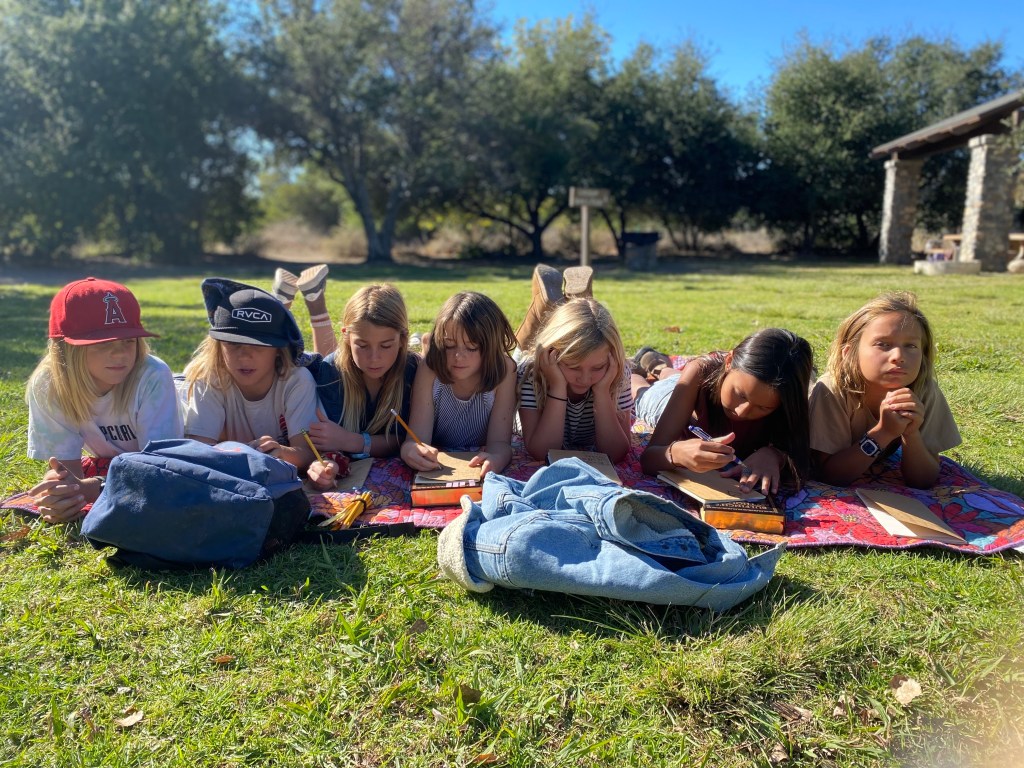
Our lessons begin at 10:15 with recitation and copywork; this term we are working through two poems by Robert Frost, “The Road Not Taken” and “Fire and Ice.” We are also working on a sonnet from “As You Like It” by William Shakespeare. Through recitation the children are learning to speak effectively. I read a few lines several times, then they have a turn to recite back; we work on this little by little on both Tuesdays and Thursdays. Copywork is for writing practice, but, primarily, in Form 2, it is for exposure to excellent writing. The children slow down and absorb punctuation details, capitalization, and outstanding prose.
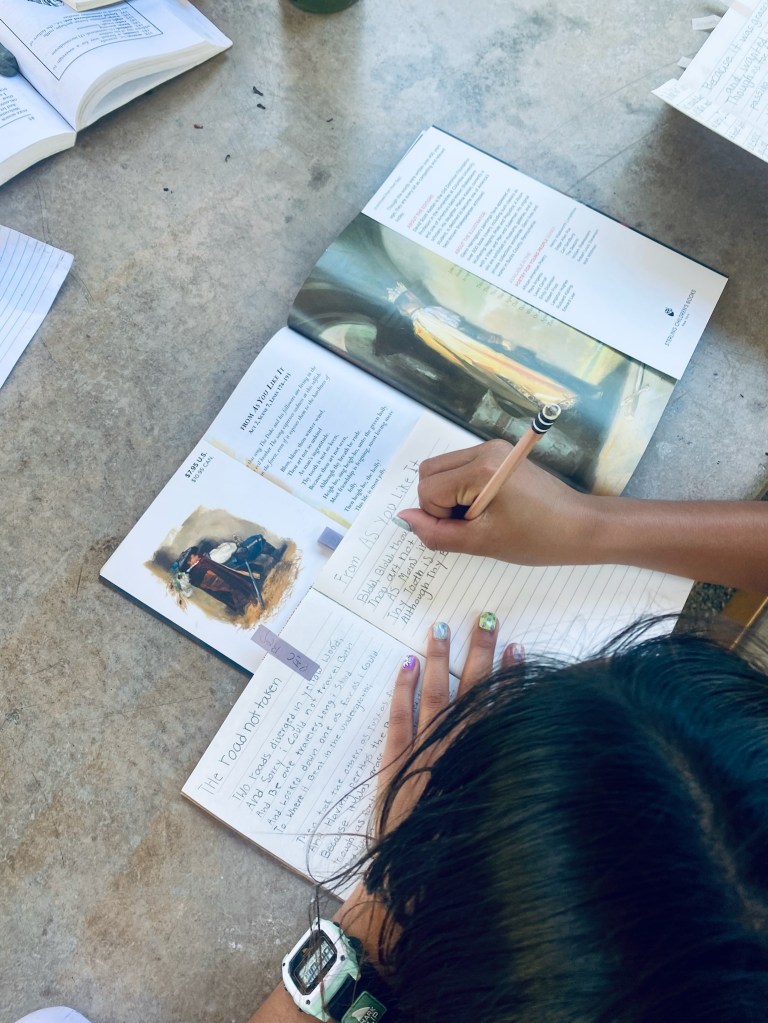
“Recitation and committing to memory are not necessarily the same thing, and it is well to store a child’s memory with a good deal of poetry learnt without labor.”- Home Education, p.122
Our first reading comes from Story of the World, a history reading- we read this on both Tuesday and Thursday. This term, we are focusing on WW1 to 1990. First we recall our last reading, then I give a brief introduction of the story we will be reading; I also highlight key people and define terms, this helps when someone comes to an unfamiliar name. Also, before the reading we find out where in the world our story is taking place with 5-10 minutes of map drills- this may look like labeling a blank map, taking turns describing the map for the given lesson using cardinal directions and relative countries, or locating on a globe. I read aloud and the students follow along in their books.
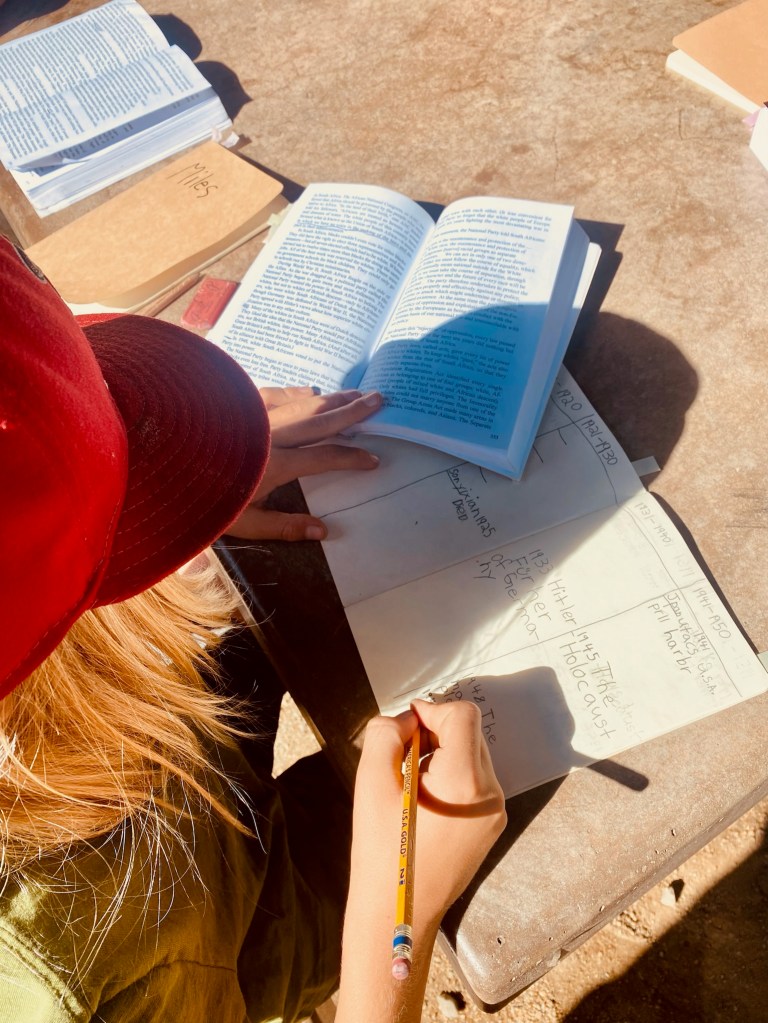
They are to be mindful of dates and after the reading we record them in a timeline they made in their map and timeline journal.


After history we need a little stretch and a snack. We get a boost from a round of grammar or mental math. On Tuesdays we have a round of grammar exercises. Using sentences from our readings or recitations, we go around in a circle locating the particular part of speech that is being studied this term and the students add the words to their word list in the grammar section of their lined notebooks and are encouraged to add to it often; so far, we have an adjective, adverb and preposition list.
Thursdays are mental math days and this is a favorite. I set a timer for 5 minutes and orally ask each child an arithmetic problem to solve mentally and quickly as possible. The questions gradually get more challenging each week. I pull the mental math questions from the Saxon mental math section for grades 4-6. Some examples are skip counting from 2-12 forwards and backwards, simple addition and subtraction.


On Tuesdays, we have been reading about the travels of Ulysses from Bullfinch’s Mythology. We begin the lesson by recalling where we left off from the last reading and we practice the tricky Greek and Roman names. We take turns reading and stop frequently to narrate. We have gotten in the habit of reading this in the sun by the creek bed or under a large oak tree a little ways off.
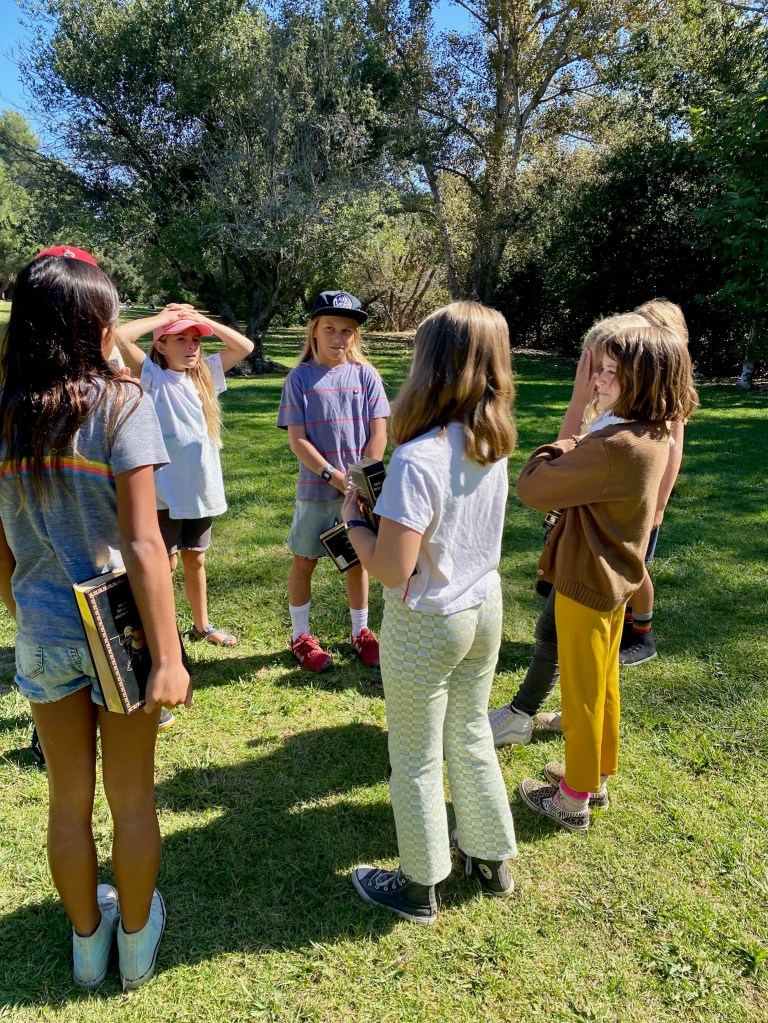
On Thursdays we are reading “As You Like It” by William Shakespeare. For this we must read in or under the oak tree. I divide parts among the students, letting them choose-this sometimes leads to a paper, rock, scissors match over a particular character and sometimes parts are shared, but everyone willingly and eagerly reads. I give a summary of the act and scene and stop frequently to narrate.
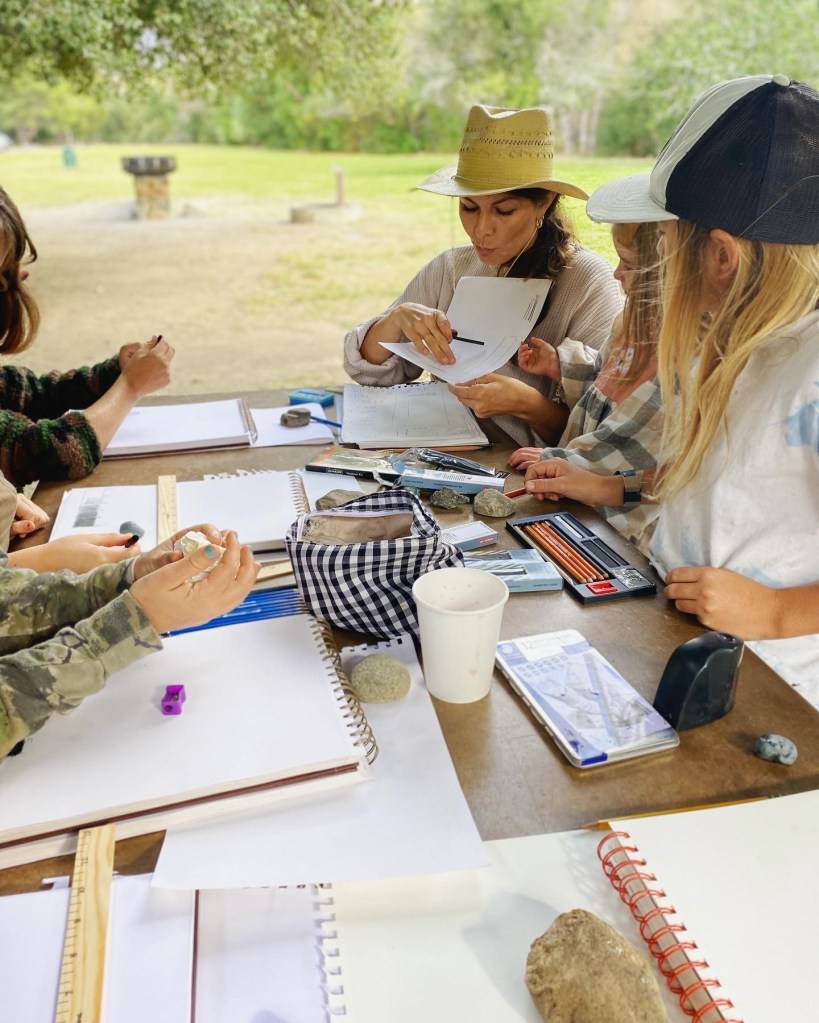
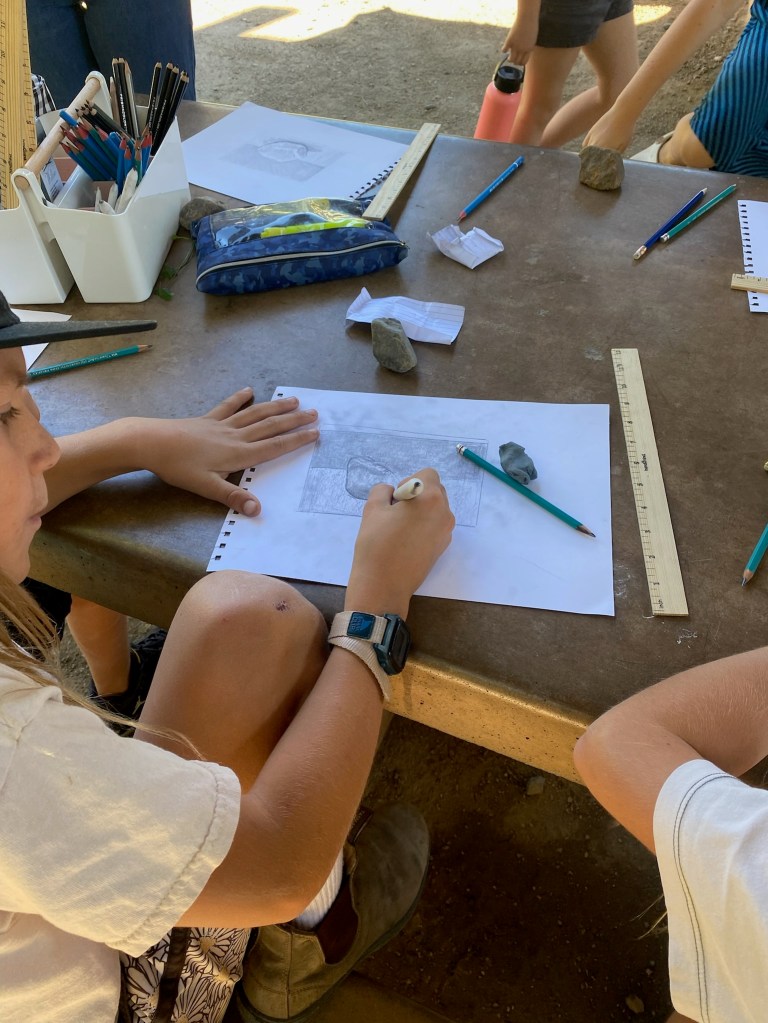
After lunch is drawing class with Brittany Reidel. Drawing lessons are such a beautiful part of the day. Brittany has been incorporating nature study into the drawing lessons beginning with the elements of art, so far, focusing on line, shape, form, and value; she is teaching the children to see, to have patience with themselves and the process of drawing. In 8 short weeks the children have grown in their abilities as well as their habit of attention.
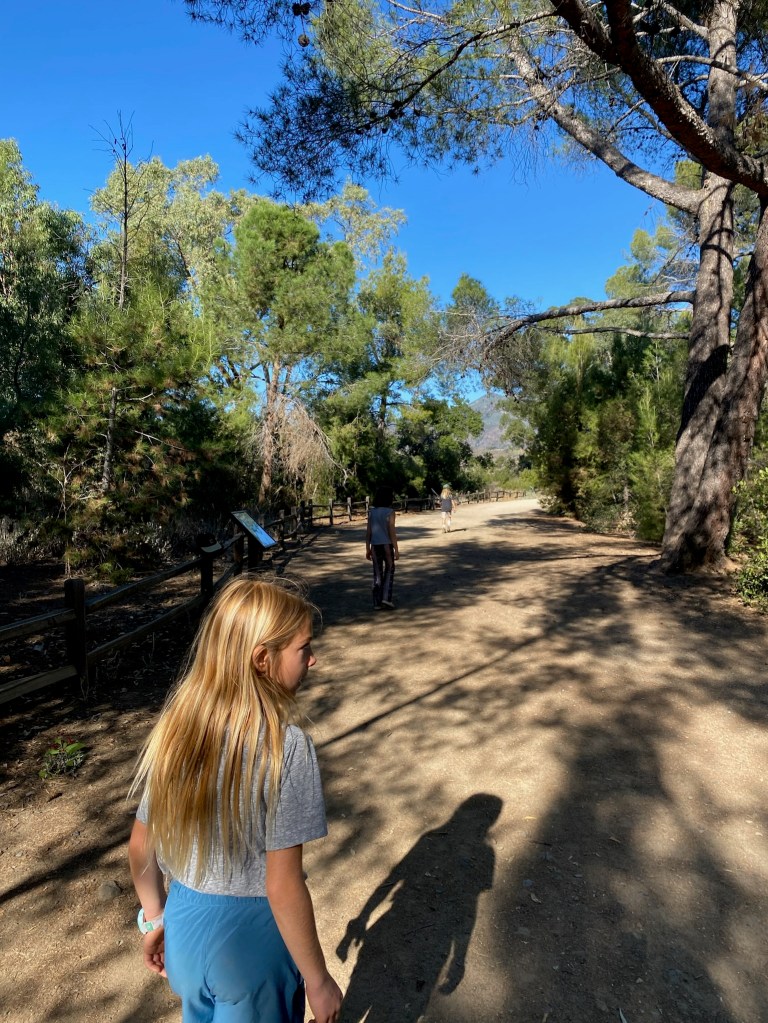
On Thursdays after lunch I have been working on growing the childrens’ ‘nature intelligence’. Psychologist Howard Gardner identifies, “‘Naturalist Intelligence’ as the base of all the rest of our thinking; it is the ability to perceive patterns on a complex fabric. Such intelligence brightens all other thinking processes and there is a great deal of brain science out there supporting the contention that being in nature is good for improving our overall intelligence. ”
In the last hour of the day we have been playing games that focus on holding attention and take them through every aspect of all five senses. For example, in “sleeping fawn” the players lie flat on the ground and remain still for an extended period of time soaking up the landscape, this game develops the ability to be comfortable with stillness and the sense of hearing. In “Eagle eye,” the hiders, or “voles/mice/rabbits” must hide themselves within a given boundary and must be able to see the eagle in the nest with at least one eye at all times. The goal of this game is to mobe the hider as close to the Eagle as possible without being seen. The Eagle has to look and listen for everyone hiding and must not leave the nest. The players are hiding, scouting and practicing invisibility, using their eyes and ears in a more focused way and practicing patience in looking at nature in a more focused way. In the game “Where Are We Now,” we take a walk on the Twisted Tire Trail; we begin by finding our orientation. Throughout the walk I ask, “Where are we now?”, and they figure out which direction we are facing along the walk.

 Live Oak Education
Leave a comment